



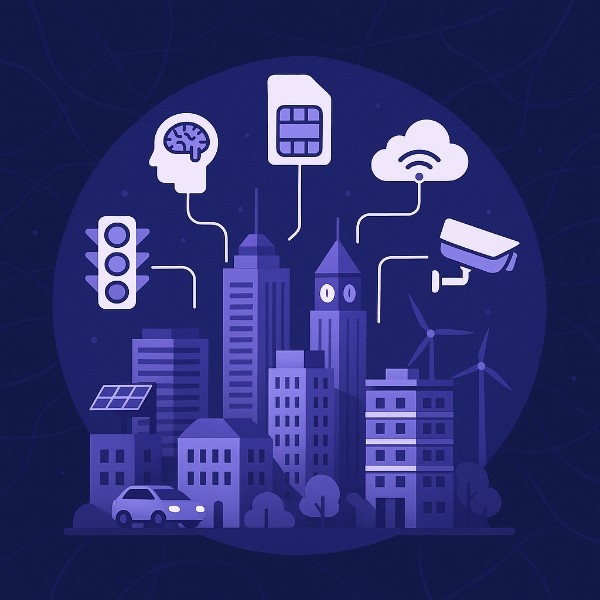
In the fast-evolving digital landscape, the convergence of Artificial Intelligence (AI) and eSIM technology is revolutionizing how urban environments function. Smart cities—once a futuristic concept—are now a reality, driven by interconnected devices, data analytics, and adaptive infrastructure. At the heart of this transformation lies the Internet of Things (IoT), which acts as the nervous system of smart cities. AI serves as the brain, while eSIM technology provides the communication channels.
This blog explores how AI and eSIM are synergizing to power smart cities and IoT, making urban spaces more intelligent, responsive, and efficient.
What Are Smart Cities?
Smart cities use digital technologies and data to improve urban life. These cities integrate infrastructure, government services, and the private sector into a seamless ecosystem that responds to the needs of residents in real time.
What Is the Internet of Things (IoT)?
IoT refers to the network of interconnected devices that collect and exchange data. These include:
- Traffic sensors
- Smart meters
- Surveillance cameras
- Connected vehicles
- Wearable devices
Together, these form the foundation of smart cities by enabling real-time monitoring, automation, and decision-making.
The Role of Artificial Intelligence in Smart Cities
AI as the Decision-Making Engine
AI processes the massive volume of data generated by IoT devices. It uses machine learning (ML), computer vision, and predictive analytics to:
- Optimize traffic and reduce congestion
- Enhance energy efficiency
- Predict maintenance needs
- Improve public safety
- Analyze environmental impact
AI Applications in Urban Systems
- Smart Traffic Management: AI algorithms analyze real-time traffic data to adjust signal timing and reroute vehicles.
- Predictive Policing: AI identifies crime hotspots, helping police deploy resources more effectively.
- Waste Management: AI forecasts optimal waste collection schedules based on usage patterns.
AI-Powered Personalization
Smart cities also use AI to tailor experiences for residents, such as personalized public transportation alerts or customized city services based on behavior analysis.
Your Journey, Our eSIM
Stay online abroad with instant activation.
What is eSIM and why does it matter?
eSIM (Embedded SIM) is a programmable SIM card embedded directly into a device. Unlike physical SIMs, eSIMs:
- Are not removable
- Can switch carriers remotely
- Support multiple profiles
- Work across a wide range of devices
eSIM vs Traditional SIM
| Feature | Traditional SIM | eSIM |
|---|---|---|
| Form Factor | Physical | Embedded |
| Activation | Manual | Remote |
| Multi-Profile | No | Yes |
| IoT Compatibility | Limited | Extensive |
Importance in a Smart Ecosystem
eSIM enables seamless global connectivity, which is essential in a city environment with thousands of IoT devices operating across various networks.
eSIM’s Contribution to IoT Infrastructure
Seamless Connectivity Across Devices
eSIM technology allows for real-time remote provisioning of connectivity profiles, making deployment of IoT devices faster and cheaper.
Improved Device Lifecycle Management
- No need to physically access devices to replace SIM cards.
- Easily scale and manage thousands of devices from a central platform.
Enhanced Flexibility
Devices can switch networks based on signal strength or cost efficiency—crucial for mobile IoT applications like autonomous vehicles or delivery drones.
Lower Operational Costs
With fewer logistics involved and remote profile management, companies save time and money in maintaining IoT infrastructure.
AI + eSIM: The Smart Duo for Smart Cities
AI and eSIM are complementary technologies. Here’s how their integration enables smarter urban environments:
1. Real-Time Data Collection and Analysis
- eSIM connects the devices.
- AI analyzes the collected data in real time.
Example: Smart traffic lights connected via eSIM send live data to AI systems that optimize light patterns dynamically.
2. Predictive Maintenance of Infrastructure
AI can detect anomalies in machinery or public utilities. eSIM ensures uninterrupted data flow to the AI models.
Example: Water supply systems equipped with IoT sensors use eSIM to report pressure levels. AI forecasts potential pipe failures, triggering preventive maintenance.
3. Efficient Energy Distribution
Smart grids use AI to forecast energy demand, while eSIM ensures real-time connectivity of all components across locations.
Example: AI adjusts electricity flow during peak usage hours; eSIM keeps smart meters constantly connected for accurate feedback.
4. Public Transport Optimization
- eSIM-equipped vehicles relay GPS and usage data.
- AI processes this to optimize routes, reduce idle time, and enhance service frequency.
5. Enhanced Public Safety
CCTV, gunshot detectors, and emergency response devices use eSIM to stay online at all times. AI processes audio and visual data to detect threats and alert authorities.
Use Cases: Smart Cities Empowered by AI and eSIM
1. Smart Traffic Management in Singapore
Singapore uses AI-powered cameras and eSIM-connected traffic sensors to monitor and manage road congestion. The system adjusts traffic light cycles in real time, significantly reducing commute times.
2. Barcelona’s Smart Waste Management
Barcelona has deployed IoT waste bins with eSIM connectivity that communicate fill levels. AI processes the data to schedule optimal waste collection routes, reducing fuel usage and emissions.
3. Water Management in Amsterdam
Amsterdam uses eSIM-connected smart water meters. AI algorithms predict consumption trends and detect leaks, reducing water loss and maintenance costs.
4. Air Quality Monitoring in London
eSIM-enabled air quality sensors feed real-time pollution data to an AI engine that identifies pollution sources, forecasts patterns, and suggests urban planning improvements.
5. Connected Emergency Services in Tokyo
Tokyo’s eSIM-integrated emergency response units provide always-on communication. AI analyzes incoming alerts, categorizes emergencies, and dispatches resources optimally.
Security and Scalability Considerations
- Data Security
AI systems require secure data pipelines. eSIM adds an extra layer of encrypted, carrier-level communication, making data breaches more difficult.
- Authentication and Identity Management
eSIMs support GSMA-compliant remote SIM provisioning, helping verify device identities, a critical factor in large-scale IoT deployments.
- Scalability
With remote provisioning, it’s easy to scale from hundreds to millions of devices—all remotely managed via a unified platform.
Challenges in Adoption
- Interoperability Issues
Different IoT devices, platforms, and connectivity providers may not always support a common standard, causing fragmentation.
- High Initial Investment
Deploying eSIM-capable hardware and integrating AI analytics can require significant upfront costs, especially for large cities.
- Data Privacy Concerns
Smart cities raise questions around how resident data is collected, used, and stored. AI systems must be transparent and ethical in handling personal information.
- Regulatory Hurdles
Telecommunication regulations and AI governance laws vary by country, making global deployments complex.
Future Outlook
5G + AI + eSIM: A Game-Changing Trio
With the rollout of 5G, data transmission becomes faster and more reliable. Combined with AI and eSIM, this trifecta promises to:
- Enable autonomous public transport
- Support remote surgeries in urban hospitals
- Power massive-scale real-time analytics
Rise of Edge AI
Edge AI, where computation happens locally on the device, will pair with eSIM for low-latency performance—ideal for traffic control systems and security cameras.
Sustainable Smart Cities
AI and eSIM will continue contributing to environmental sustainability by optimizing energy usage, reducing emissions, and promoting efficient resource utilization.
Conclusion
The union of AI and eSIM technology is shaping the future of smart cities and the IoT landscape. While AI empowers intelligent decision-making, eSIM ensures uninterrupted and secure connectivity for millions of devices. From traffic lights to smart waste bins, these technologies are quietly but profoundly enhancing our urban lives.
As cities become more connected, the seamless integration of AI and eSIM will be pivotal in building sustainable, efficient, and people-centric urban environments. Though challenges exist, the benefits far outweigh them, making this technological duo the backbone of smart cities of tomorrow.
Global Coverage, Local Rates
Experience hassle-free connectivity wherever you go.
Seamless Mobile Data Everywhere













 English